
How to Check Criminal History in Kalamazoo County
Begin with the kind of fact you need. The MiCOURT Case Search is the first stop for filed adult criminal cases. Select the countywide 8th District Court for misdemeanors and the early stages of every felony. Add the 9th Circuit Court when a felony may have been bound over. Current county custody belongs in the KCSO Inmate Inquiry, while a public statewide history comes from the Michigan State Police repository. A sheriff or city police report still has to come from the agency that wrote it.
Use a complete legal name, prior names, likely spelling forms, and date of birth when the system accepts it. A name match alone does not prove identity. Case and booking numbers are stronger keys because they point to one file or custody event.
- Search MiCOURT by participant name or case number in both Kalamazoo County criminal courts when a felony is possible.
- Check the KCSO inmate roster for current or recent county custody, using booking dates to narrow the results.
- Use ICHAT when a name-based Michigan repository record is needed, and compare all available descriptors.
- Request the incident or arrest report from KCSO, KDPS, Portage Public Safety, or the other agency that created it.
- Ask the court clerk or records office for an official copy before relying on a key event or disposition.
Kalamazoo County Record Searches Compared
Four official systems answer four different questions. MiCOURT follows a filed case. ICHAT reflects the public part of the Michigan State Police criminal-history repository. KCSO Inmate Inquiry is a live county custody tool, and OTIS covers current or recent MDOC incarceration and supervision. A person can appear in one and not another for sound reasons, such as release from jail, a charge that was not authorized, a local offense outside ICHAT, or a transfer to state custody.
| Channel | Best use | Main limit |
|---|---|---|
| MiCOURT | Charges, hearings, docket events, outcome | Online data is not the official clerk file |
| KCSO Inmate Inquiry | Current and recent county booking status | A live roster is not a full arrest history |
| ICHAT | Public Michigan repository history | Excludes warrants and several record classes |
| OTIS | MDOC custody, probation, or parole | Not a county jail or court docket |
When an entry matters, trace it back to the office that created it. That step is more reliable than treating a database gap as proof that an event never happened.
Official Michigan Background Checks
The Internet Criminal History Access Tool is Michigan's public name-based product. The Michigan State Police Criminal Justice Information Center charges $10 for an ordinary search. It requires first name, last name, gender, and date of birth. ICHAT can show public Michigan felony and qualifying misdemeanor information, but it omits warrants, suppressed matters, juvenile, traffic, federal, tribal, out-of-state, and local-misdemeanor records. It is neither a nationwide file nor a complete Kalamazoo County court history.
A person reviewing their own fuller Michigan record may follow the MSP fingerprint process. The request uses an FBI FD-258 or similar card, a cover letter, and a $30 payment mailed to CJIC. Results go only to the fingerprinted person and MSP advises allowing three to five weeks. Statutorily authorized fingerprint checks use an RI-030 form and an approved Live Scan vendor. Vendor charges vary. The FBI offers its own subject-only Identity History Summary for $18 through the FBI electronic request portal.
| Product | Fee | Scope |
|---|---|---|
| ICHAT name search | $10 | Public Michigan subset |
| MSP personal fingerprint review | $30 | Subject's own Michigan record |
| Extra certified original | $1 | Added copy with personal review |
| FBI Identity History Summary | $18 | Subject-only federal record |
Kalamazoo County GovQA Record Requests
The Kalamazoo County Sheriff's Records Section is the fallback for reports created by KCSO. Written requests can be sent by mail, fax, the county email link, or the Sheriff GovQA portal. KCSO does not take report orders by phone, though it recommends calling Records first to ask whether a report is ready for release. Give a date or date range, location, people involved, and a report or complaint number when known. A clear description helps staff locate the existing record without guessing.
County GovQA separates Sheriff records from requests to other county departments. That choice matters. A Kalamazoo city police report stays with KDPS, while a Portage report stays with Portage Public Safety. Michigan FOIA ordinarily calls for an initial response within five business days and allows one extension of up to ten business days. Fees depend on search time, labor, copying, and direct retrieval cost. An approved county Affidavit of Indigency can waive $20, generally no more than twice in a calendar year, and requires a notarized signature.
Types of Criminal Records in Kalamazoo County
Kalamazoo County criminal records form a chain rather than one master file. A police agency creates the incident and arrest report. KCSO creates the booking record for people lodged at the county jail. The Prosecuting Attorney reviews the investigation, and the courts preserve filed charges, hearings, orders, and outcomes. CJIC later connects qualifying fingerprints with prosecutor and court reports. Each custodian can hold facts that do not appear in the public product of another office.
- Incident and arrest reports: agency narratives, alleged conduct, evidence references, and officer actions.
- Booking records: custody intake, lodged charges, bond, release, and transfer data kept by KCSO.
- Court case files: complaints, docket events, pleas, orders, disposition, and sentence.
- Repository records: qualifying Michigan arrest cycles and reported outcomes tied to CJIC.
- Supervision and registry data: limited public OTIS status and statutorily public PSOR entries.
Warrants require special care because ICHAT excludes them and no comprehensive public KCSO warrant database was found. Verify a possible bench or arrest warrant with the issuing court and KCSO.
Kalamazoo County Criminal Courts
Both adult criminal courts work from the Judge Charles A. Pratt Justice Center at 330 Eleanor Street in Kalamazoo. Every adult prosecution starts in the 8th District Court. It handles arraignment and bond, resolves misdemeanors, and holds the probable-cause conference and preliminary examination in a felony. A supported felony then moves to the 9th Circuit Court for arraignment on the information, plea or trial, and sentence.
The shared building does not merge the files. Search both courts after bindover and use the right clerk counter for copies. The 8th District public line is 269-384-8171. Its normal hours are Monday through Thursday from 8 a.m. to 4:30 p.m. and Friday from 8 a.m. to 4 p.m.; it closes at 3:30 p.m. every third Tuesday. The 9th Circuit Criminal Division can be reached at 269-383-8837 and is open weekdays from 8 a.m. to 5 p.m.
8th District Criminal
330 Eleanor Street
Kalamazoo, MI 49007
269-384-8171
9th Circuit Criminal
330 Eleanor Street
Kalamazoo, MI 49007
269-383-8837
KCSO Records Section
1500 Lamont Avenue
Kalamazoo, MI 49048
269-385-6191
What a Kalamazoo County Criminal Record Shows
The fields depend on which Kalamazoo County record is open. A repository history is built around a fingerprint-linked arrest cycle and later reported outcome. A court file is organized around a case number and register of actions. A booking detail is a custody snapshot. Matching those formats prevents a lodged allegation from being mistaken for the charge the prosecutor filed or the result the judge entered.
| Name and identifiers | Public name, aliases or prior names, and available descriptors; protected identifiers are withheld. |
|---|---|
| Arrest and booking | Arresting agency, booking time, initial allegations, bond, custody, release, or transfer fields. |
| Charges and statutes | Offense text, Michigan law citation, level, and any attempt marker or later amendment. |
| Disposition | Dismissal, acquittal, plea, conviction, or another recorded outcome for each count. |
| Sentence | Terms imposed after conviction, including jail, prison, probation, fines, or restitution when public. |
| Custody or supervision | Current jail status or limited MDOC incarceration, probation, and parole information. |
Note: A docket event may be public even when the filing itself requires a separate clerk copy request.
Kalamazoo County Criminal Record Flow
The path begins with the agency that investigates an event. If an adult is arrested for a felony or reportable misdemeanor, booking staff take fingerprints and a photograph. CJIC can then associate the event with a state identity record rather than a name alone. The Kalamazoo County Prosecuting Attorney reviews the investigation for legal and factual support before a complaint and warrant are authorized. This review is why an arrest does not always become a filed charge.
Record flow: Police report › KCSO booking › prosecutor review › 8th District Court › 9th Circuit Court when bound over › CJIC disposition reporting.
Reporting lag, a mismatch, a local offense outside ICHAT, a set-aside, or an unfiled allegation can create differences among the systems. Verify the end result in the court record.
Public Access Laws for Kalamazoo County Criminal Records
Michigan uses different access rules for agency records and court records. A request for a KCSO or city police report proceeds under FOIA and may be redacted for a valid exemption. Courts are excluded from FOIA's public-body definition, so inspection and copying of a public case file instead follow Michigan Court Rule 8.119 and the clerk's local process. CJIC, set-aside, and sex-offender records each have separate statutes that control what becomes public.
Key authorities:
Michigan FOIA, MCL 15.231 to 15.246 gives access to nonexempt records held by local and executive public bodies.
MCL 28.241 and following governs fingerprint collection, criminal-history reporting, and repository records.
Michigan Court Rule 8.119 controls inspection and copying of public court case records.
MCL 780.621 to 780.624 covers application and automatic set-asides and retained nonpublic records.
Juvenile information, victim details, active-investigation material, personal identifiers, and records restricted by statute, rule, or order can be withheld.
Kalamazoo County Warrant Record Chain
No complete public KCSO active-warrant name search was located. MiCOURT can show docket clues, but it is not a real-time warrant list. ICHAT expressly excludes warrants. For a district or traffic case, call the 8th District Court at 269-384-8171. For a felony event, call 9th Circuit Criminal at 269-383-8837. KCSO can route a verification request at 269-383-8821 or through the nonemergency line at 269-488-8911. Releasable warrant records may also be requested through Sheriff GovQA.
An arrest warrant authorizes custody, while a bench warrant often follows a failure to appear or comply. A search warrant authorizes a search, and a supervision warrant concerns alleged probation or parole noncompliance. Sealed and juvenile warrants are not ordinary public material. A person trying to resolve their own possible warrant should confirm directly with the court and obtain legal advice before appearing unexpectedly.
Sealed, Expunged, and Restricted Records
Michigan calls conviction relief a set-aside and also uses the term expungement. Application-based relief goes to the court of conviction. The general waiting periods are three years for one or more misdemeanors, five years for one felony, and seven years for more than one felony, measured from the latest event set by law. Offense exclusions and count limits apply, so the headline period alone does not establish eligibility.
Automatic Clean Slate began April 11, 2023. Under MCL 780.621g, eligible misdemeanors generally become automatic after seven years from sentence, while an eligible felony generally requires ten years from sentence or release from prison, whichever is later. A set-aside makes the conviction nonpublic. It does not mean each official trace has been physically destroyed. To verify one's own result, check ICHAT, request the MSP fingerprint-based personal record, and contact the convicting Kalamazoo County court. If an old entry persists, send the order to the custodian of that specific docket, repository entry, OTIS entry, or agency report.
Kalamazoo County Sheriff Record History
The official KCSO history traces the office to 1830. It says the first sheriff's own home served as the first custodial site, with his widow acting as jailer. A wooden jail followed near present-day Bronson Park in 1835. Later buildings reflected the county's growth before jail operations reached the modern Lamont Avenue complex.
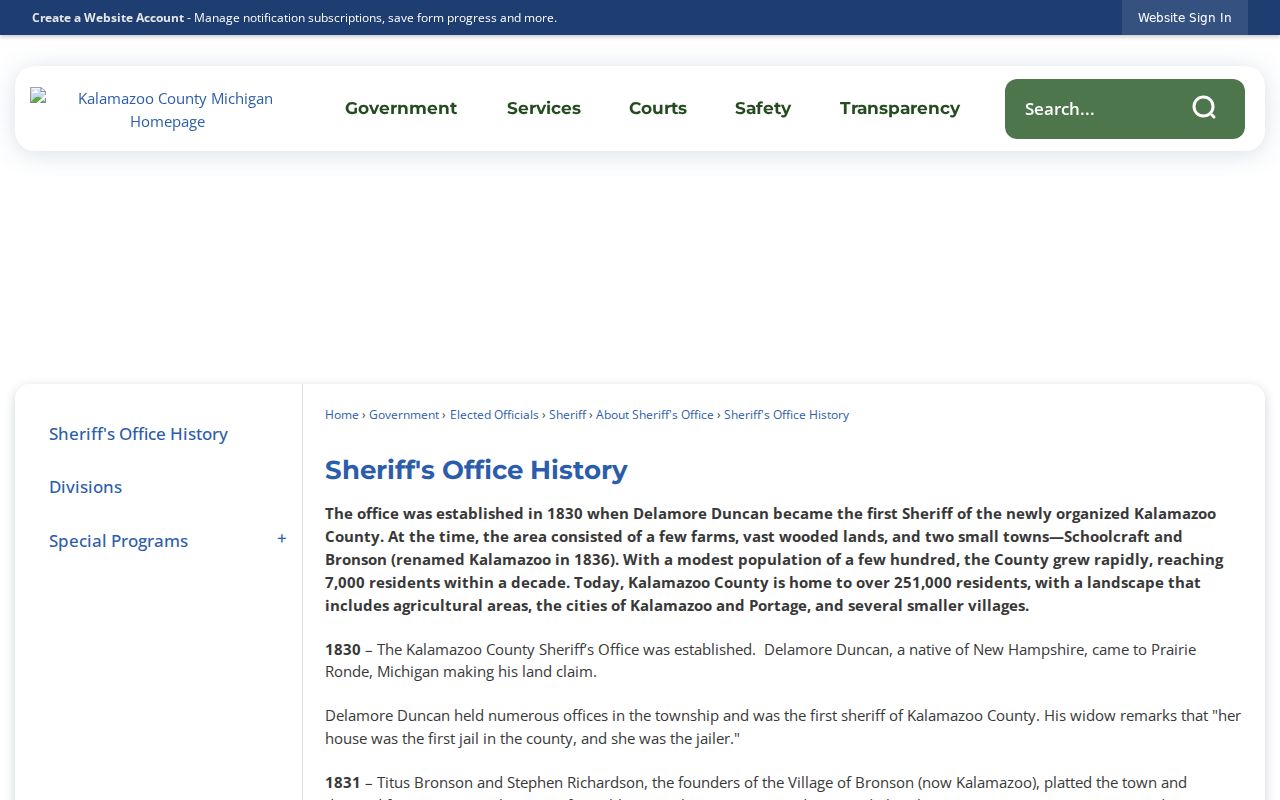
The long chain from a home jail to today's booking system helps explain why historical custody research may require archives or a written records request rather than the live inmate roster.
Kalamazoo County State Record Paths
The Michigan State Police criminal-history page separates ICHAT from fingerprint review, court data, and corrections records. That distinction is useful when a Kalamazoo County event does not appear in a name search.
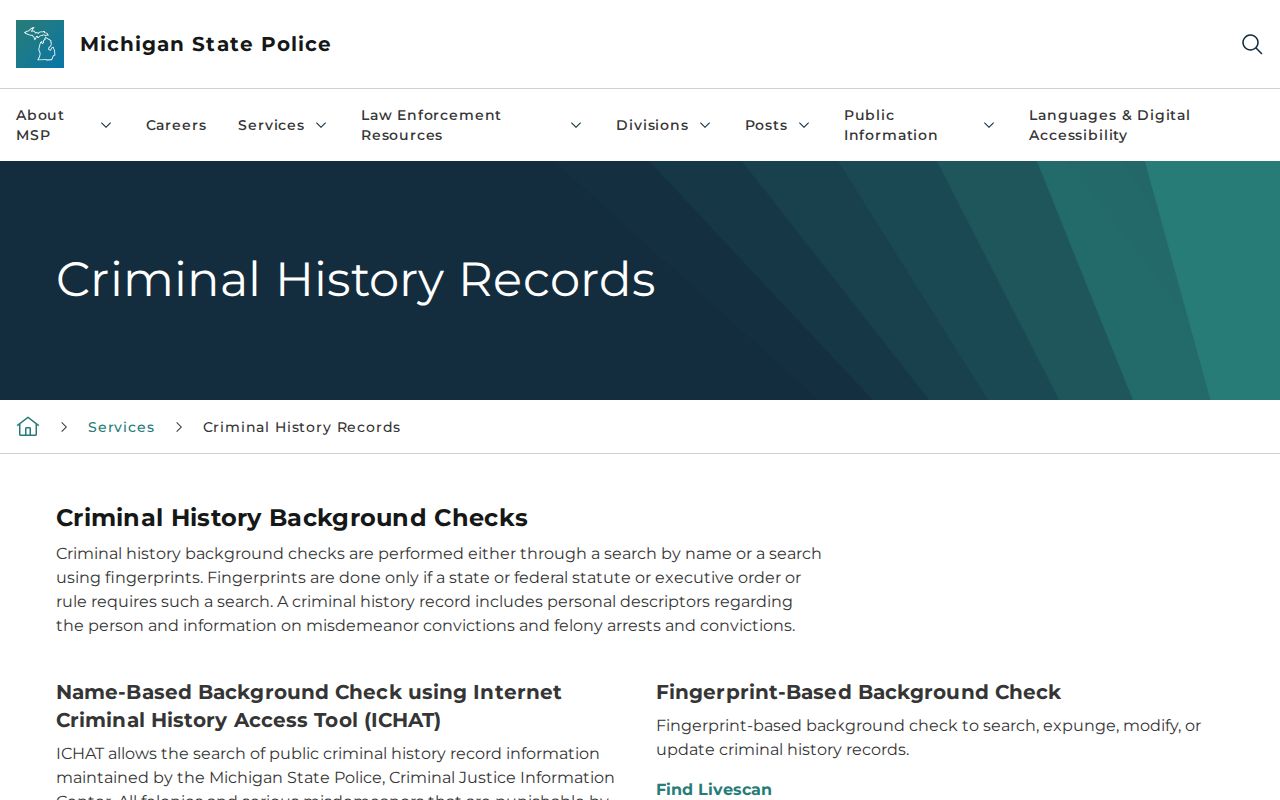
Use OTIS after a sentenced person enters MDOC custody or supervision. Its public entries generally remain for three years after discharge, unless a set-aside removes them sooner. Misdemeanor probation remains with the Kalamazoo County 8th District Court Probation Department, while MDOC Field Operations handles felony probation and parole. A missing OTIS result does not rule out a past county case or a different form of supervision.
- ICHAT
- MSP's public name-based Michigan repository search.
- MiCOURT
- The case-search system used by participating Michigan trial courts.
- OTIS
- MDOC's locator for current or recent state custody and supervision.
- Register of actions
- The court's dated list of filings, hearings, orders, and other case events.
Criminal Records by City in Kalamazoo County
Kalamazoo, Portage, and Galesburg police records remain with the city that created them even though adult criminal cases converge in the countywide 8th District Court. The city path matters most when requesting an incident report. None of the three cities runs a separate municipal criminal court. The cards below lead to local records contacts and explain how each city report reaches KCSO custody, the county courts, and CJIC.
Kalamazoo Criminal History
73,598 · KDPS reports use the city records and FOIA channels.
Portage Criminal History
48,891 · Police and fire requests use Portage's dedicated workflow.
Galesburg Criminal History
2,049 · The city clerk coordinates FOIA requests for police records.
Kalamazoo County Criminal Record Context
The Census Bureau's county profile places an estimated 263,795 residents across 561.96 square miles in 2025. That scale creates many police custodians, but adult cases still flow into one countywide district court.
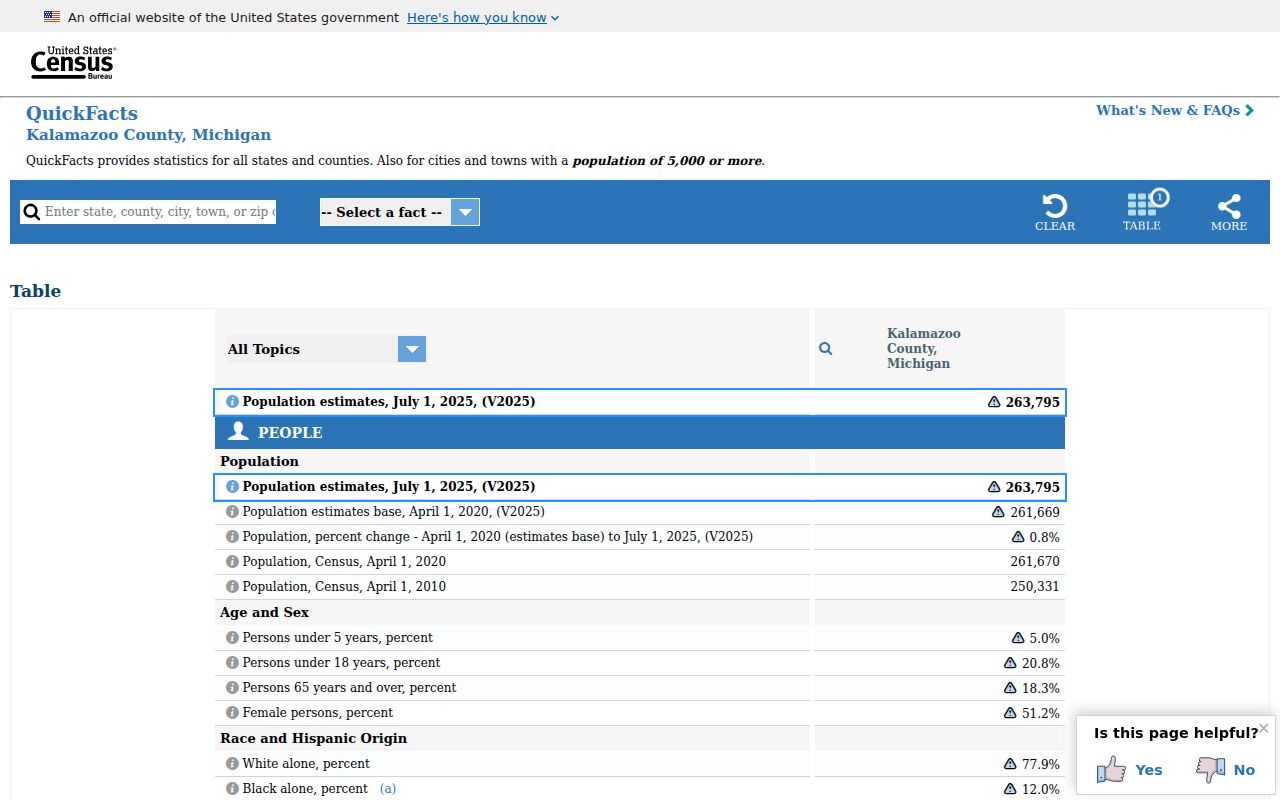
KCSO patrols more than 500 square miles for over 105,000 residents, while Kalamazoo, Portage, townships, campus agencies, and smaller cities keep their own reports. The 1999 consolidation of three district courts explains why city ordinance cases and adult misdemeanors now share the 8th District Court even though their police reports remain separate.
The county's 2024 workflow figures are timing measures, not guilt rates or neighborhood risk scores. The courts reported that 79 percent of statute and ordinance misdemeanor cases were adjudicated within 63 days of first appearance and 97 percent within 126 days. For felony, extradition, and detainer matters, 30 percent of preliminary examinations occurred within 14 days of arraignment and 63 percent within 28 days. Those figures help a searcher judge where a new file may be in the process, but the live docket and clerk remain the sources for a specific case.