
How to Check Criminal History in Kalamazoo
A useful Kalamazoo search begins by naming the record, not by entering a name in every public tool. KDPS holds Kalamazoo incident, traffic, arrest, and crash reports. The county jail holds the Kalamazoo custody entry. The countywide courts hold the filed Kalamazoo complaint and later docket. Michigan State Police holds the public repository slice in ICHAT. Since those files answer different questions, a missing result in one place does not show that no Kalamazoo event occurred.
- Ask KDPS Records for the Kalamazoo police or traffic report, using the report number, date, place, and names when known.
- Use the Kalamazoo Request Center, email, mail, or the records counter for a written public-record request.
- Check KCSO Inmate Inquiry when the question concerns current or recent county custody.
- Search both Kalamazoo County courts in MiCOURT for the charge, hearings, and disposition.
- Use ICHAT only for the public Michigan repository record, then confirm it against the court and source agency.
The broader Kalamazoo County criminal history overview explains why Kalamazoo warrants, supervision files, and state records may require other official channels. At Kalamazoo altitude, KDPS is the right first stop for the report that began with a Kalamazoo officer.
Four Kalamazoo Police Record Routes
Kalamazoo offers four written ways to seek Kalamazoo records. A requester may create an account in the Kalamazoo Request Center, email FOIA@kalamazoocity.org with “FOIA Request” as the subject, mail a request to the Kalamazoo City Attorney, or use the records counter. The Kalamazoo portal supports email confirmation and status tracking. A phone call to 311 or 269-337-8000 can answer process questions, but Kalamazoo does not accept a FOIA submission by phone.
The official Kalamazoo public-document page shows the city’s online route and request rules.
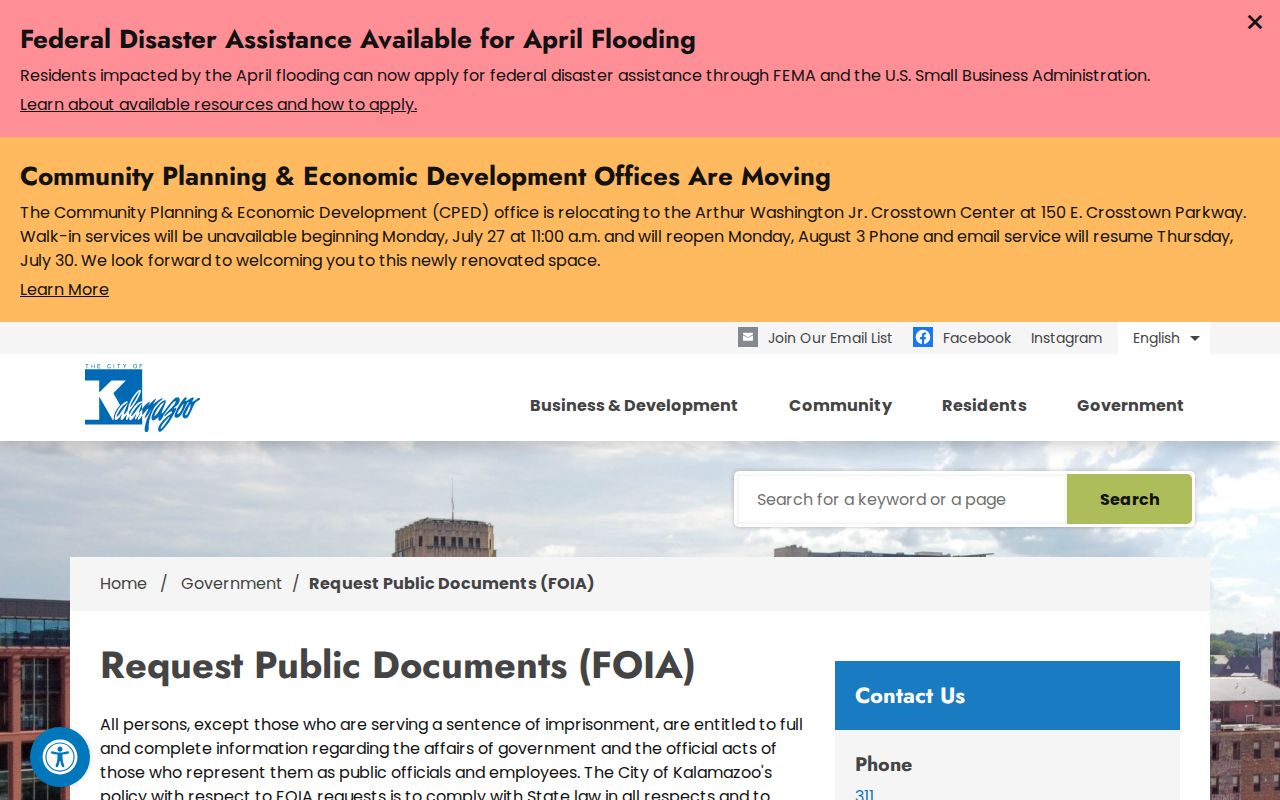
That screen matters because the Kalamazoo request is separate from a county Sheriff request. Give a clear description, date range, Kalamazoo department, and preferred delivery method so staff can locate an existing record without guessing what is sought.
The Kalamazoo Police Department
The police function is part of the combined Kalamazoo Department of Public Safety. KDPS is based at 150 E. Crosstown Parkway, Kalamazoo, MI 49001. Its Records lobby is open weekdays from 8 a.m. to 4 p.m. The direct Records numbers are 269-337-8106 and 269-337-8120, and the records email is KDPSRecords@kalamazoocity.org. The unit handles police reports, traffic reports, local checks, firearms licensing, and outside record requests.
The official KDPS department page identifies the Kalamazoo public-safety agency.
The Kalamazoo agency remains the custodian of its report even after an arrested person enters the county jail. Kalamazoo crash reports may be requested from Records by email or through the city-authorized LexisNexis process.
KDPS Records
150 E. Crosstown Parkway
Kalamazoo, MI 49001
269-337-8106 or 269-337-8120
Weekdays, 8 a.m. to 4 p.m.
Kalamazoo Record Fees and Deposits
Kalamazoo follows a defined response and payment path. Kalamazoo ordinarily gives its initial FOIA response within five business days and may take one ten-business-day extension. That response may grant access, deny part or all of a request, seek payment, or report that no responsive Kalamazoo record was found. The deadline is a response deadline, not a promise that every requested copy will arrive in five days.
When the estimated cost exceeds $50, Kalamazoo may require a 50 percent deposit. Prior unpaid FOIA fees may cause Kalamazoo to require 100 percent. Kalamazoo records are held pending payment, and a request closes after 45 days of nonpayment. These rules make a focused description useful: a tight date range, report number, Kalamazoo event site, and record type can reduce search work and avoid an overly broad estimate.
Arrests and Bookings in Kalamazoo
A KDPS arrest creates several Kalamazoo records, but Kalamazoo does not keep a separate public jail roster. The officer’s Kalamazoo incident and arrest report remains with KDPS. A Kalamazoo custodial arrest moves to the Kalamazoo County Jail, where booking staff assign identifiers, take fingerprints and a photograph, document property and lodged charges, and classify the person for housing. The current custody entry is then searched through the official KCSO inmate inquiry.
Booking is not a verdict. The prosecutor may authorize, amend, or decline charges, and the court file can differ from the officer’s first allegation. For recent activity, search the jail by name and booking dates, call KCSO if intake or release timing creates a gap, and then search MiCOURT. The full county channel sequence appears in the Kalamazoo County arrest history resource.
The county’s official quick-links page points residents to jail and other government lookup systems.
This county step is needed only for custody and later case routing. It does not transfer ownership of the original KDPS police report.
Kalamazoo Police Reports Versus ICHAT
A KDPS report and an ICHAT result are not two copies of one Kalamazoo file. The Kalamazoo report may contain the incident narrative, officer observations, time and place, alleged offenses, property or evidence references, and supplements that can lawfully be released. ICHAT is a name-based public repository product assembled by Michigan State Police from reportable fingerprint and disposition data. It does not provide the complete Kalamazoo report.
- KDPS report
- The city agency’s account of a Kalamazoo event, subject to FOIA exemptions and redaction.
- Booking record
- The county jail’s intake and custody snapshot, including lodged charges and release or bond status when public.
- ICHAT record
- The public state repository slice, which excludes warrants, federal, tribal, traffic, juvenile, local-misdemeanor, out-of-state, and suppressed material.
- MiCOURT docket
- The participating court’s public case events, charges, hearings, and disposition information.
For a correction, first identify which custodian shows the disputed fact. Sending a court disposition to KDPS will not by itself correct a separate CJIC repository entry.
Kalamazoo Municipal Court Records
Kalamazoo has no separate municipal criminal court. The county’s district-court history records the 1999 consolidation, so city ordinance matters, traffic cases, adult misdemeanors, and the first stages of felonies now run through the countywide 8th District Court. A felony supported after preliminary examination is bound over to the 9th Circuit Court. Both courts sit at the Judge Charles A. Pratt Justice Center, 330 Eleanor Street in Kalamazoo.
| Court Name | Countywide 8th District Court, followed by 9th Circuit Court for bound-over felonies |
|---|---|
| Case Types Heard | City ordinance and traffic matters, adult misdemeanors, felony arraignment and preliminary stages; Circuit handles felony trial and final disposition |
| Case Lookup Channel | MiCOURT Case Search or the court clerk; District Court phone 269-384-8171 |
| What the Docket Shows | Case number, filing date, status, public parties, charges, hearings, docket events, and public disposition data |
| Copies & Fees | Inspect or request copies through the court of record; online information is not the official court record |
A Kalamazoo ordinance web page only states the local rule. It is not proof that a Kalamazoo case was filed or that a person was convicted.
Searching Kalamazoo Criminal Court Records
MiCOURT supports a Kalamazoo name route and a Kalamazoo case-number route. Select Kalamazoo’s 8th District Court for misdemeanors and early felony stages. Search the 9th Circuit Court as well after a Kalamazoo felony bindover. A case number is the best key when it is known because similar names and partial-name behavior can produce several results. Filters may include case category, type, year, status, date of birth, judge, and sort order, though visibility varies by court.
MiCOURT is informational. Older matters, nonpublic categories, and documents may require direct clerk contact. Some courts use a seven-year criminal-sentence filter, and an attempted felony can display a felony level even when Michigan law treats the attempt as a misdemeanor. Check the attempt marker, statute, and court file before drawing a conclusion.
Where Kalamazoo Records End Up
The path out of city custody is clear once each file is kept distinct. KDPS writes the report and submits an investigation. The county prosecutor decides whether to authorize a complaint. Every adult criminal prosecution starts in the 8th District Court, and a supported felony later moves to the 9th Circuit Court. Reportable fingerprints, charges, and dispositions are sent to MSP’s Criminal Justice Information Center.
Record flow: Kalamazoo Department of Public Safety › Kalamazoo County Courts › Michigan State Police Criminal Justice Information Center
A recent city event may appear first at KDPS or in the county jail. A filed case belongs in MiCOURT. ICHAT may update only after qualifying data reaches CJIC, and its public result still will not include every city, court, federal, or out-of-state record.
Kalamazoo Criminal Record Fingerprints
KDPS does not offer routine digital Live Scan service except for arrests and court-ordered appearances. For a digital fingerprint appointment, KDPS directs people to Kalamazoo Township Police at 269-567-7523, extension 5. KDPS does offer ink cards for a fee and stocks FD-249, FD-258, and RI-008 cards. The distinction is easy to miss when a form merely says “fingerprints.”
A fingerprint-based check is not an open public search. Michigan uses approved Live Scan channels when a statute, executive order, or rule authorizes the check, and the initiating authority supplies the required process. A person who wants to review or correct their own Michigan record follows MSP’s personal record-review path. Vendor prices and appointment terms vary, so confirm the approved location before arriving.
Kalamazoo Neighborhood Record Boundaries
Kalamazoo’s 22 named neighborhoods and large college presence create a practical agency-boundary issue. KDPS handles city calls, yet campus agencies may create the report for an event on institutional property. Western Michigan University, Kalamazoo College, and other campus safety offices keep records they create. The county Sheriff does not absorb those reports merely because a later booking occurs at the county jail.
The official Western District of Michigan page also marks the separate federal layer.
A federal investigation or prosecution is searched through the federal court and federal custody systems, not KDPS, MiCOURT, or ICHAT. Start with the responding agency named on the incident paperwork whenever jurisdiction is uncertain.
Kalamazoo Criminal Custody Layers
City arrest records can point to several custody systems over time. KCSO shows current and recent county booking. OTIS covers people in current or recent Michigan Department of Corrections custody or supervision, and its public entries generally remain for three years after discharge. Federal custody uses the Bureau of Prisons locator. These systems should not be merged into one timeline without checking identifiers and dates.
The official Federal Bureau of Prisons locator is the source for federal custody.
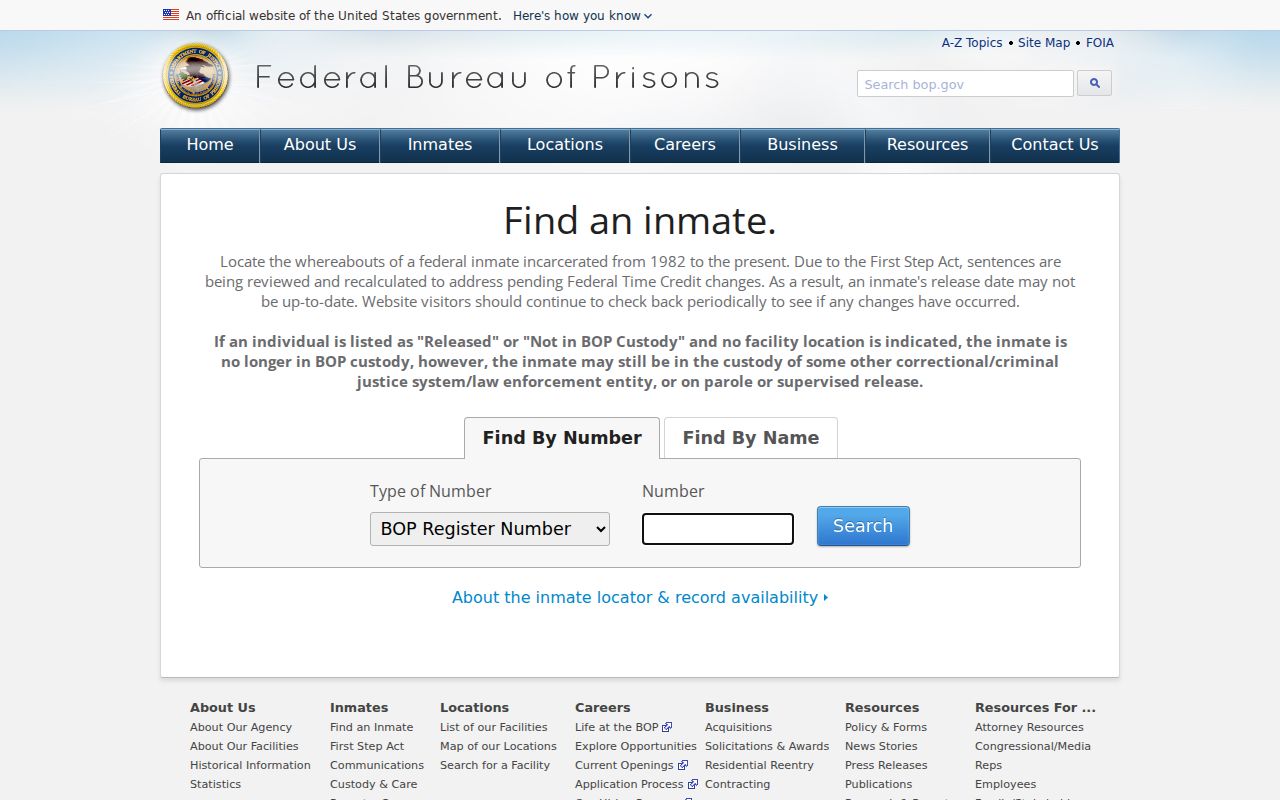
A person absent from the federal locator may still have a city report, a county case, or a state supervision record. Each system reflects its own jurisdiction and retention rules.
Public Access Rules
Michigan FOIA governs nonexempt records held by Kalamazoo and KDPS. It does not govern judicial records because Michigan courts are outside FOIA’s public-body definition. Public court access instead follows Michigan Court Rule 8.119 and any statute, court rule, case law, or sealing order that restricts a file. Victim information, personal identifiers, juvenile material, active-investigation details, and suppressed records may be redacted or withheld.
The official KDPS request-records page describes the city records channel.
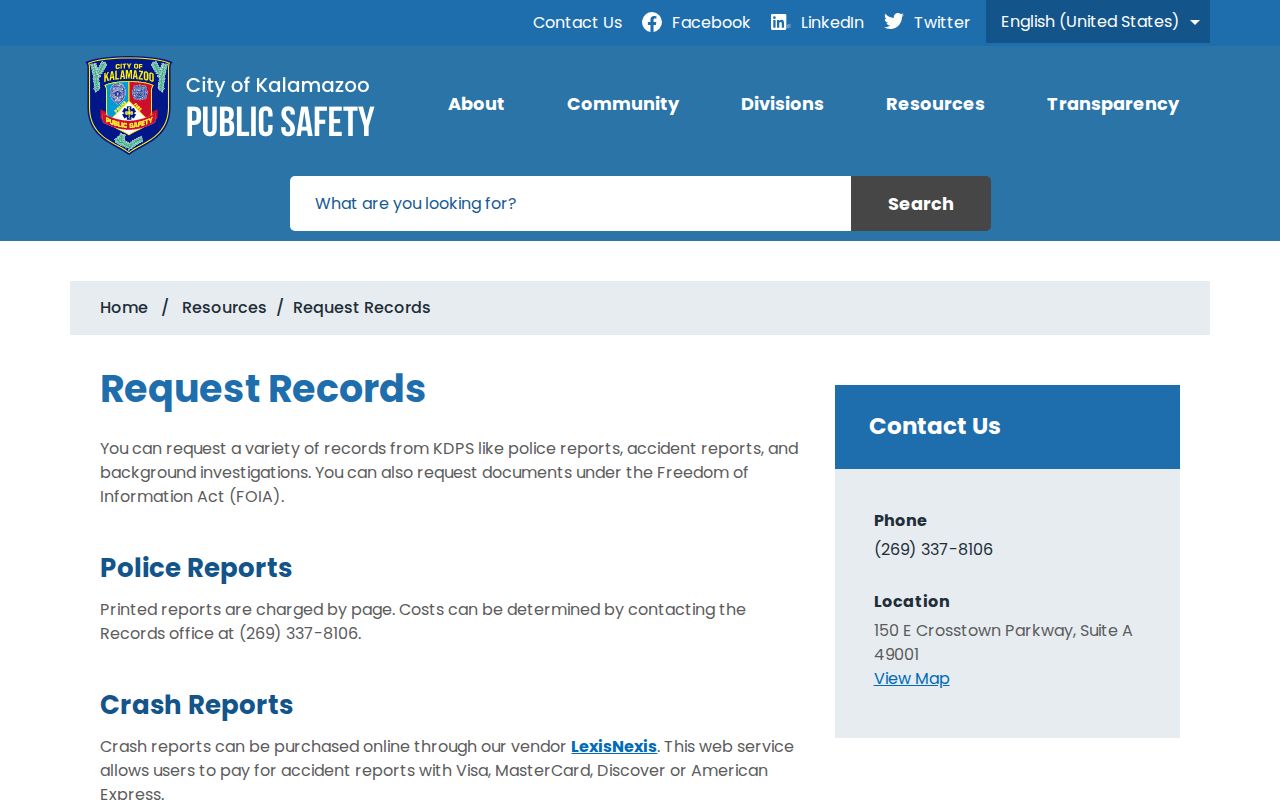
The request route shown there applies to city agency files. Court inspection and state repository searches use their own rules.
Key Statutes:
Michigan Freedom of Information Act, MCL 15.231-15.246 gives access to nonexempt city agency records.
Bureau of Criminal Identification and Records Act governs arrest fingerprints, repository records, and disposition reporting.
Michigan Court Rule 8.119 governs inspection and copying of public court records.